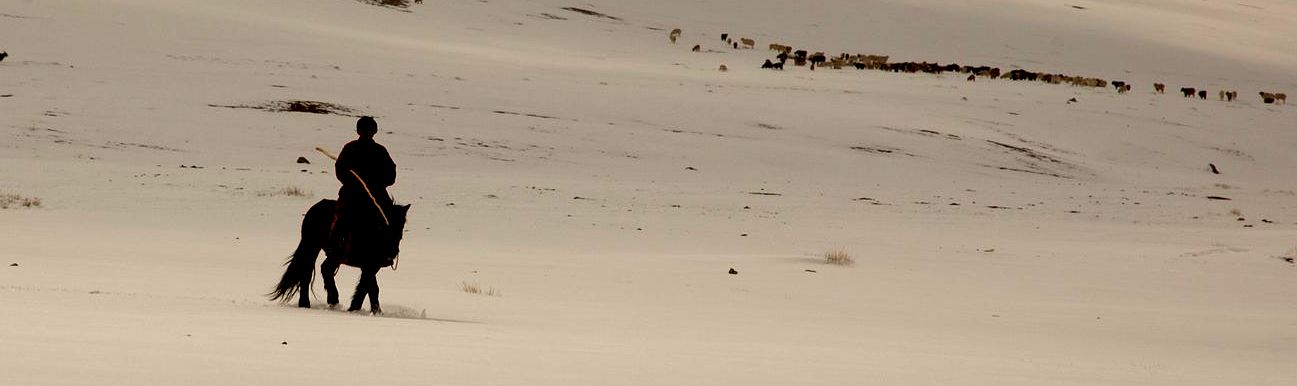
WinternomadeGrowing up I was always moving from city to city. This might be the reason I never established roots anywhere until later in life when the decision to choose a place I could call home was all mine. I am an only child and I never met my father; this experience left me unattached to the memories of family life circumscribed by a specific geographical area. I felt loose, unrestrained, unfettered by that sense of belonging that prevents people from stepping outside their comfort zone. I was already outside my comfort zone. I felt different and unable to relate to other kids who shared an extensive family life.
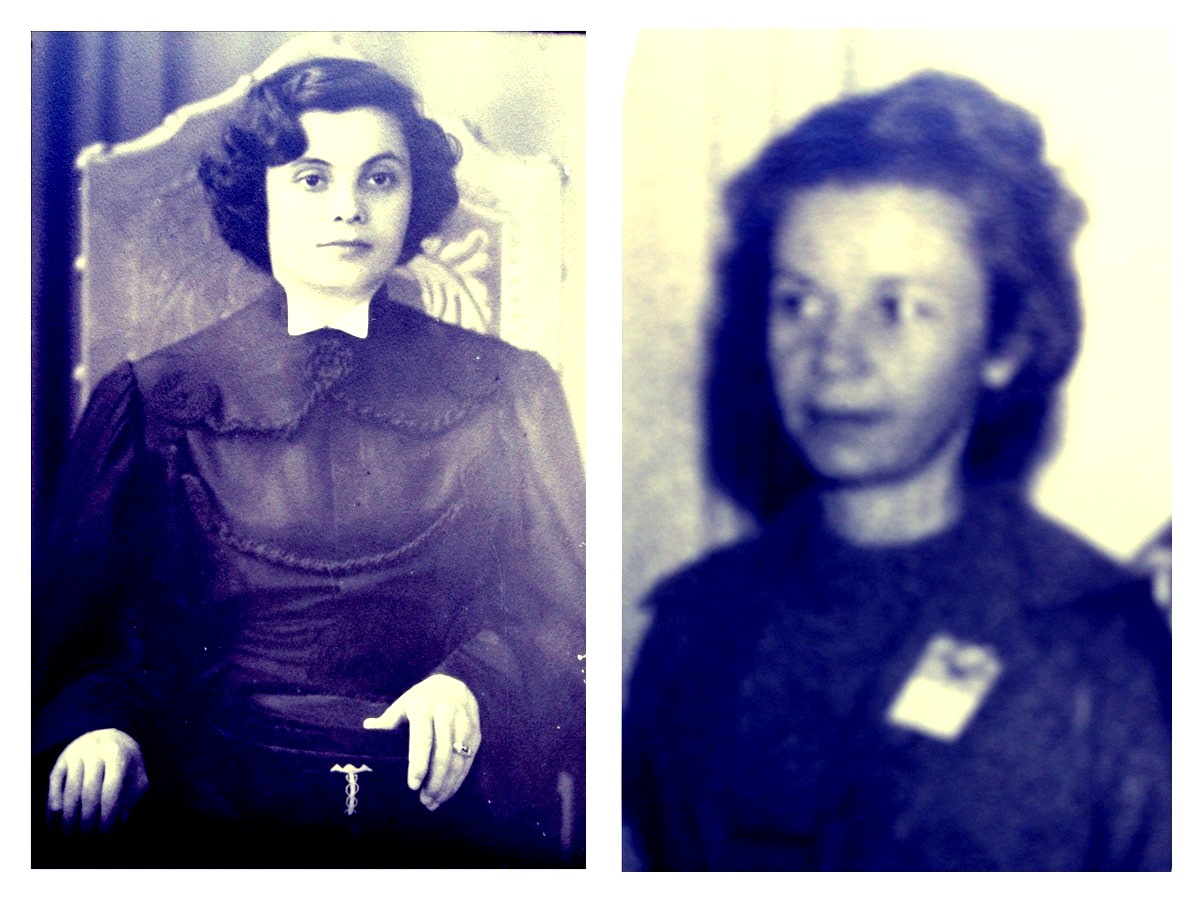
mom_auntIn my experience, the nomadic character of my childhood was beyond my control and I had to follow the two people who raised me: my mother, and my aunt who was then often stationed in different regions throughout the country as a chief nurse. They raised me together and I had no choice but to go with them – not that I have any complaints on that respect. On the contrary, I believe my life was exponentially improved by being exposed to this constant change of places. Later in life, I made my own decision of where I wanted to live.

Syr_Darya_Oblast._Kyrgyz_Migration_WDL10987 (1)Now I consider all those people who are nomadic by nature, who are constantly moving from one city to another, one state to another, one country to another; many times with no more than two years apart between places. What drives them to move? What impels them to start again in a new place?

Perhaps, a dissatisfaction with the way their lives are going drives them to a constant search for a different place that will give them the chance to start anew; a blank slate or canvas where they can rewrite their own stories, in an attempt to avoid the mistakes they deem responsible for their uneasiness and discontent. Starting again in a new place, where nobody knows us, might bring a nub of relief from the self-imposed pressure coming from an erroneous belief that we might have failed somewhere, somehow. We never truly fail. But we beat ourselves up when we think we did, and leaving the place where things supposedly went awry, will at least boost the morale and open the flow of energy once again.
Man_on_Mars2

BUT, GOING TO MARS?

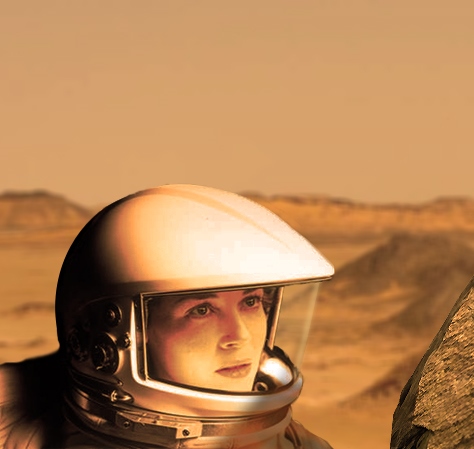
In 2011 a nonprofit foundation announced its plan to take the first humans to Mars and establish the first settlement, a new colony. A staggering number of more than 200,000 people replied to the primary selection phase of the Mars One Mission. What motivates people, from all over the world, to take part in this unique scientific experiment that seems so risky and ostensibly far-fetched? It is, undeniably, a brave and laudable decision that those embarking on this journey have made when they applied to fill in the four-person spaceship on their one-way ticket to Mars.

The reasons are different from person to person, but the one aspect this varied and large group seems to have in common is the belief that they are opening a new frontier to mankind, and that they are willing to take upon the risks – even if it means disintegrating, in a matter of seconds, while entering the Mars’ atmosphere, if the angle of entry is not quite as it should be. Furthermore, they also defend the idea that life on earth, under the evolutionary pattern we have been following, is reaching its demise and extinction. There isn’t much hope, or a rational positive prognostic, that reversing this old and devastatingly stagnant model is possible to achieve. Considering the level of dissociation that human beings have been identified with, and the ensuing relationship with the very system that societies at large have adopted in their increasingly competitive global economic race, we are all in big trouble.

600px-MARS-VikingThrough the examples of the people who responded to the initial selection to go to Mars, it is hard, and quite disturbing, to imagine someone leaving their wife and kids behind to pursue this dream of finding a higher purpose and meaning in their lives. Somehow it feels that some of these people are lost or confused in a world that spawns isolation and social dislocation due to a mechanized lifestyle that stifles one’s individuality and uniqueness. It is rather unsettling to listen to these people because we feel incapable of disputing their motivations and reasoning. It is just disheartening and doleful to see the amount of personal suffering that individuals go through, to the point that they would rather choose to be dead for the people they are leaving behind on earth than committing to struggling and finding their way around the chaos in their lives. Some may even say this mission could be a new form of suicide with a higher purpose and legacy as the main rational justification for making that choice. In any case, it is a personal choice and one that has profound social, psychological and spiritual ramifications for everyone.

The initial phase of the selection process has already started; registration opened in 2011 and it’s now closed. The cost to send the first four people going to Mars is 6 billion US$. Some of the applicants have appeared in interviews that make up interesting short movies about this mission. One candidate is only 18 years of age and mentioned that he never had sex or kissed anyone in his life. Another applicant said that love is not something that she needs and that nobody has ever had that effect on her. So are these the qualities they will be looking for in the perfect candidate to start this new era of human evolution on another planet? Love and human emotions will no longer be seen as an important and defining trait of humanity?

NASA_Mars_RoverI have mixed feelings towards this enterprise. I can’t make up my mind as yet. I would like to think that our Earth still needs to be looked at from the perspective of a live organism and not some decaying system soon to be discarded. I am well aware of the overwhelming and critical problems we face due to overpopulation, but I would still like to think that we could revert this process, if only the focus would be given to social and economic justice and education in a large scale, on all levels. I’m not saying we should not explore the universe, but to see other human beings ready to embrace this journey, leaving Earth behind forever, makes me feel a longing and nostalgia for something that is quite indefinable and which I struggle to grasp.

The first group of four to embark on this unprecedented journey is scheduled for 2024. The crew will travel through space for 210 days on their way to Mars. Once they land safely on the Red Planet’s surface, they will go through a period of readjusting to gravity, recovering from the long journey, and starting the settlement necessary for their survival. Subsequent missions will arrive every two years with other groups of four each.  Each succeeding mission will cost 4 billion US$. This is an ambitious mission, not only financially, but also in terms of the magnitude of the project.

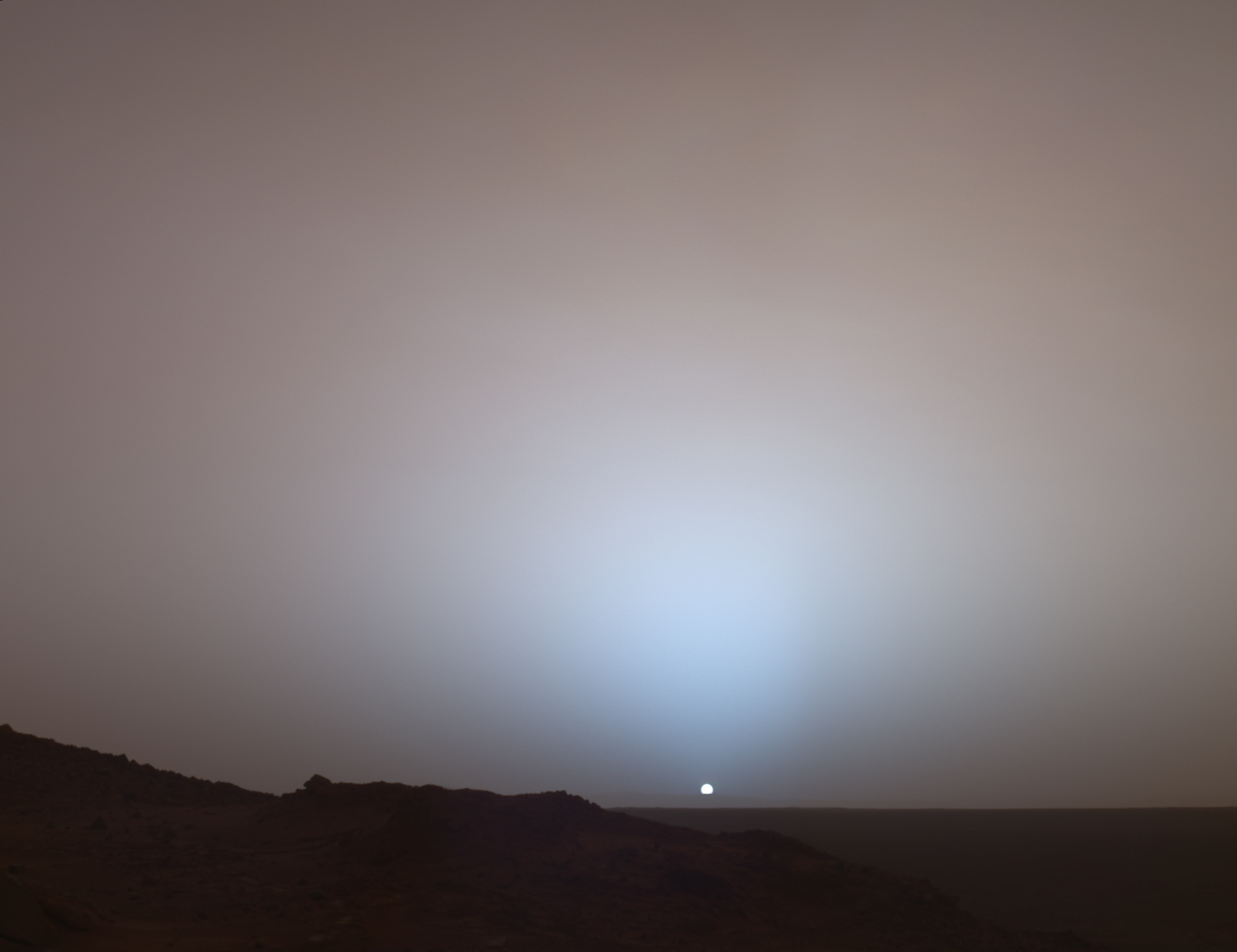
779px-MarsSunsetI am a firm believer that we should explore and cross new frontiers in order to improve, evolve and expand our knowledge of the universe and ourselves. However, I also feel that the most fundamental stepping stone to humanity’s advancement comes, first and foremost, from within. Carved inside Apollo’s Temple at Delphi was the famous maxim: “Know Thyself”. This ancient maxim has been exhaustively explored in its possible meanings, but the reference to a personal investigation seems almost impossible to ignore. It is through self-knowledge that man can syllogistically come to understand others and the reality around. The inescapable, but preventable, social problems we have been experiencing since the birth of our civilization suggest a dearth of this primary knowledge, for we still feel separate from one another, and identify our relationships as possible threats to our survival, much like our primitive ancestors responded to the challenging unknown world around them.

ArtificialFictionBrainHow can we explore other worlds as possible sites for the perpetuation of our species if we are not able to establish a functional community here on earth that is no longer defined in terms of force, economic clout and political anomaly? How can we envisage a new society on a far-away planet if we can’t embrace each other’s differences, and as a result, often resort to war, segregation, violence and genocide to resolve disputes? How can we create a new community if we carry the old model within?  My biggest fear in such a visionary enterprise, that the Mars One Mission is planning to carry out, is not the recognizable and conspicuous risks of this journey, but how the individuals who succeed to land safely on the red planet will engage in a healthy relationship among themselves. Are they going to be able to create a new community, or will they repeat a similar pattern to the one we already have here?

Comet-SidingSpring-Passing-PlanetMars-On-20141019-ArtistConcept-20140905Whoever wishes to apply to participate in this mission needs to be at least 18 years of age; there’s no maximum age to apply as long as the candidate meets the normal medical and physical requirements. One fact that needs to be understood is that once you initiate this journey, there’s no ticket back to Earth. The astronaut will be saying good-bye to family, friends and loved ones forever, and Earth will only be a distant image in their cherished memories. It is a hard choice to make. I admire those people who are brave enough to sacrifice their lives by leaving our planet and their homes to open a new frontier to mankind; their true motivations only known to themselves.

I feel that there’s an intense thrill of discovering a new world, much like the way the early colonizers sailed away in search of new places to explore. Wasn’t it the way the Americas were colonized by Portugal and Spain in the 15th century, and later on the West Indies by the British, the Danish and the Dutch from the 17th to the 19th centuries? Are we starting a new phase of colonization with a space imperialism of sorts?

koyaanisqatsi_400x400Godfrey Reggio’s movie “Koyaanisqatsi: Life Out of Balance” came out in 1982 and left me with this impending sense of doom that our civilization was led to despair and extinction. In the movie, sumptuously choreographed with startling images and haunting soundtrack and cinematography, Reggio silently and eerily suggests, that technology is not to blame for the state of moral corruption and turmoil (in the Hopi definition of the movie title), we are experiencing, but rather our own relationship with the systems we have created in our society from politics to language, culture and religion – to name a few of the interconnected elements that influence our perceptions of the world we live in. It is our relationship with these systems that will define how we approach technology and make use of it to recreate the paradigm of society founded on the blueprint of our beliefs. Before we attempt to save our species by transporting people to other planets, we need first to activate a shift in conscience that will validate the reason to perpetuate our species and our evolution. Or else, we might end up saving a failed civilization that has long become extinct without our knowing.

Messier_91_(M91)Of course we need to explore, of course we need to investigate, but not without acknowledging our own problems first, lest we don’t recreate the same images of crumbling existence and ongoing suffering we constantly see in the world today in astounding proportion. It is as if man is still the prisoner deep down below in Plato’s Cave, taking the shadows he sees as the real world while some freed men dare to escape and realize for themselves the truth of the real world. Never fully understood, these “freed men” are, ironically, taken for fools or lunatics. In Plato’s theory of education, knowledge is the process of remembering or anamnesis, but in our civilization we seem to remember nothing. We don’t seem to learn from history because the facts show that we continue to repeat, through new technology, the dominant and savage model of warfare. Are we doomed to live in the darkness of ignorance as the cave men we once were?

Copy_of_earth_and_moon_photo_taken_by_ISSI like to think that the world is still a beautiful place filled with inspiring examples of love and tenderness brought forth by people like us all over the world. These people inspire me to be greater and to believe in the pure essence of the human spirit, unencumbered by the illusion of separateness and isolation. I believe in life and that we are able to recreate a model of existence with our choices and actions, breathing together as one live organism rooted on this planet in absolute interconnectedness.

I salute and command these courageous people who are dreaming of leaving their legacy, as explorers of a new planet, to the future generations. I admire their courage and support their decision. As for me, I am ready to continue my journey of self-exploration, on this planet, with the other more than seven billion individuals, not quite ready to leave this wonderful world yet.

MARS ONE MISSION PAGEhttp://www.mars-one.com/

For those interested to learn more about this mission here are four short films that show the thoughts of some of the people who registered for the initial selection phase:

1- MARS CALLING

2- IF I DIE ON MARS

3- MARS ONE WAY

4- MARS ONE

_________________________________________________

All photos are from Wikimedia Commons. Credit and info below:

1) By D Mitriy (Own work) [CC BY-SA 3.0 (http://creativecommons.org/licenses/by-sa/3.0)%5D, via Wikimedia Commons; https://upload.wikimedia.org/wikipedia/commons/f/f7/Colonization_of_Mars.jpg

2) “Winternomade” by Honza Soukup – http://bit.ly/1FYjpb7

3) “Syr Darya Oblast. Kyrgyz Migration WDL10987” by Kun, Aleksandr L., 1840-1888 – http://bit.ly/1BfsRUJ

4) By D Mitriy (Own work) [CC BY-SA 3.0 (http://creativecommons.org/licenses/by-sa/3.0)%5D, via Wikimedia Commons; https://upload.wikimedia.org/wikipedia/commons/1/1d/Man_on_Mars.jpg

5) By Viking mission team (NASA/JPL) [Public domain], via Wikimedia Commons; https://upload.wikimedia.org/wikipedia/commons/a/a9/MARS-Viking.jpg

6) By NASA/JPL/Cornell University, Maas Digital LLC [Public domain], via Wikimedia Commons; https://upload.wikimedia.org/wikipedia/commons/d/d8/NASA_Mars_Rover.jpg

7) By NASA’s Mars Exploration Rover [Public domain], via Wikimedia Commons; https://upload.wikimedia.org/wikipedia/commons/6/69/MarsSunset.jpg

8) “ArtificialFictionBrain”. Licensed under CC BY-SA 3.0 via Wikimedia Commons – https://commons.wikimedia.org/wiki/File:ArtificialFictionBrain.png#mediaviewer/File:ArtificialFictionBrain.png

9) By NASA/JPL-Caltech [Public domain], via Wikimedia Commons – https://upload.wikimedia.org/wikipedia/commons/d/df/Comet-SidingSpring-Passing-PlanetMars-On-20141019-ArtistConcept-20140905.jpg

10) Koyaanisqatsi – movie credits – http://eviltwinbooking.org/films/koyaanisqatsi/

11) “Messier 91 (M91)” by Jschulman555 – Own work. Licensed under CC BY-SA 4.0 via Wikimedia Commons – https://commons.wikimedia.org/wiki/File:Messier_91_(M91).jpg#mediaviewer/File:Messier_91_(M91).jpg

12) “Copy of earth and moon photo taken by ISS” by Larrypearson1 – Own work. Licensed under CC BY-SA 4.0 via Wikimedia Commons – https://commons.wikimedia.org/wiki/File:Copy_of_earth_and_moon_photo_taken_by_ISS.jpg#mediaviewer/File:Copy_of_earth_and_moon_photo_taken_by_ISS.jpg

Closeup of candle flame.The lights go down; the curtain goes up: with these two simple actions a universe of mystery is brought to life. On the stage the actors are no longer people, but living incantations and personifications of attributes that relates to us on the realm of symbols and myriad archetypes, speaking to us from the ancient tombs of our prehistoric ancestors. Such is the life and strength of theater. From the darkness of the room we sit in silence watching the flickering of light and bodies moving in an imagined landscape that trace the contours of our minds in search for an identification that will purge us from inside out.

My experience with theater took place organically through experimentation with the material elements that put together the farce. I can say I was lucky to be exposed, from an early age, to the great minds of theater writers and their literary concoctions and transubstantiation into the scene.

file0001516182134

To me, the theater has always been the place of the absurd, the chaos and the madness of human beings. It has always been a fertile ground that seeded my imagination and made me soar high with the ability that the creative mind has to understand and reflect man’s chaotic existential experience in contradictory and absurd ways. It is from the chaos that we make sense of our existence.

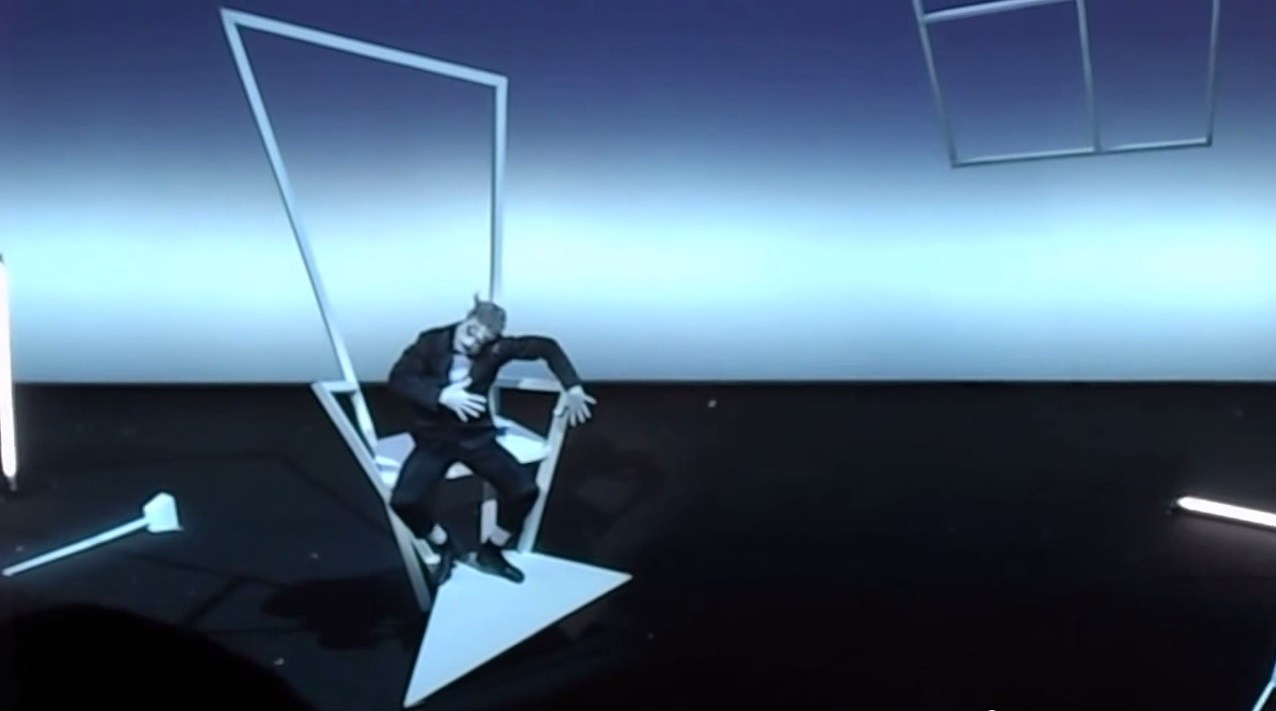
I was fortunate to watch Robert Wilson’s The Old Woman in the fall of 2014, a special treat from a dear friend. This was my first exposure to Wilson’s work and I have to confess that I was fascinated by his genius. This is the kind of theater I want in my life. That’s the kind of theater I was exposed when I was in college and that’s how I forged my theater experience. For a long time I have been craving this intensity on the stage. I was tired of experiencing the same stale productions that left me bored and dissatisfied. I needed to be challenged  in a multisensory level in order to transcend the limitations of my reality and reach that space that connects me with the performance beyond the sphere of logic and simplified linearity.

daniil kharms1The Old Woman was brought to the stage by a combination of talents starting with the text itself. Daniil Kharms wrote this exquisite and superb absurdist piece on the cusp of WWII in 1939 in Russia. It is a story about a writer facing writer’s block. He is determined to sit and start writing on the idea of a miracle worker who does not perform any miracles, not even to benefit himself. The only thing the writer brings himself to write is the sentence: “The miracle worker was tall”. From this point on, a series of fantastic encounters and bizarre events take place, defeating his inspiration to write. The presence of the old woman in the beginning of the story opens a space for many interpretations of what the old woman might mean. Perhaps, she doesn’t even mean anything at all; alluding to the possibility of lack of meaning in our own existence, or in any task an individual might become involved with. We are always trying to attach meaning to events and to the objects around us. It is in this sense that the figure of the old woman questions the very essence of our unquenchable need for meaning.
ow7The old woman holds a clock without any hands and when asked what time it is she points out that it is exactly a quarter to three.

The old woman shows up at the writers quarters uninvited. She enters his room and soon falls dead. It is at this point in the story that the writer faces his predicament. It is his own inability to write that somehow brings about the surreal nature of his situation. He now needs to get rid of the corpse, or, in his own words, the carrion of this old woman. He initially intends to contact the super of his building but all his efforts are in vain.  Outside, he meets a lady while waiting in line at a bakery. He establishes a connection with this woman but can’t invite her over to his apartment until he gets rid of the corpse.
ow3When he is back in his place, the dead old woman keeps disappearing and reappearing in the most phantasmagorical circumstances. In one moment the old woman is advancing towards him on all fours in a menacing manner; in the next, she’s back in the same position as before, still dead. The story culminates when the writer takes matters on his own hands and decides to put the body of the old woman in a suitcase and dump her in a swamp. The writer has a friend whom he initially would have liked to ask for help but decides not to for fear that he would not understand. While riding the train to dispose of the corpse, the suitcase containing the body of the old woman mysteriously disappears. The writer finally completes his manuscript that strangely seemed to be following its course all along in the story itself.

daniil kharmsDaniil Kharms’ story is quite open to interpretations, but in my opinion it reveals the challenges and obstacles a writer experiences during the process of writing. It is a visionary tale of sorts; a symbolic play with words, a sleight of hand brilliantly crafted and performed by the writer, but unnoticed by the reader until the end.

Darryl Pinckney’s adaptation of the text to the stage is outstanding. He deconstructs Kharm’s story and puts it together in an innovative collage that composes a mosaic and reveals a palimpsest of subtle images and influences that incorporate Russian folklore, myth, song, Russian language and avant-garde art, each layer carrying the collective imaginary of the culture that motivated Khrams’ oeuvre.

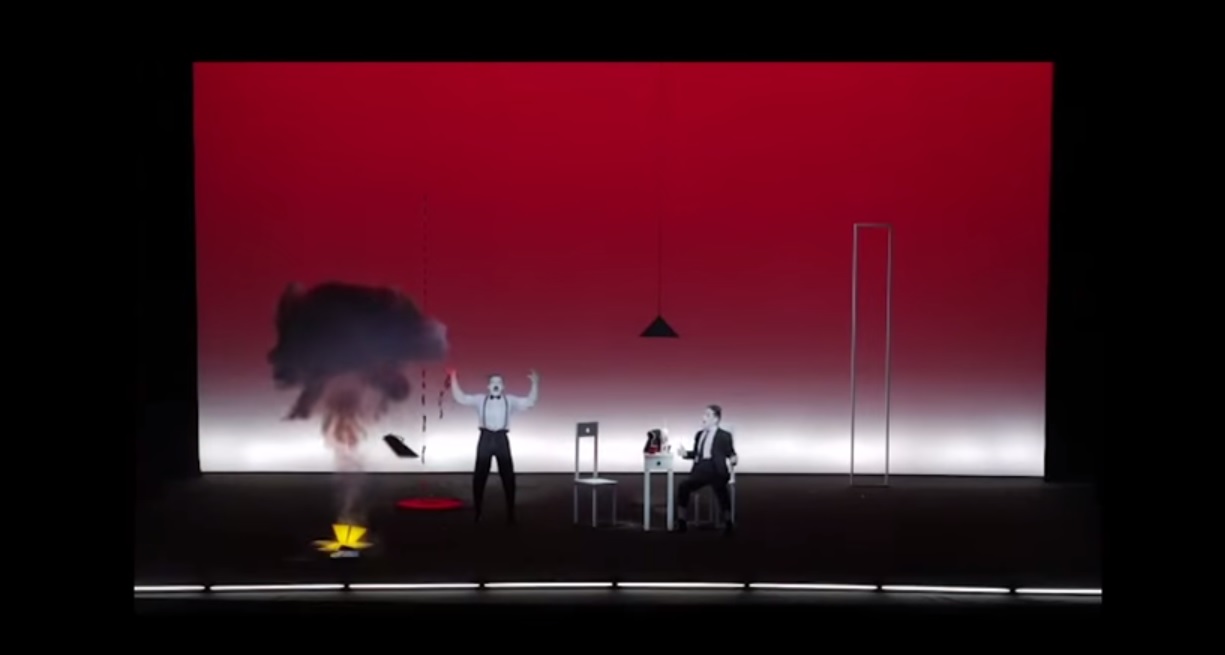
ow_wilsonRobert Wilson’s orchestration of the mis-en-scène adds another intricate layer to Daniil Kharms’ story. It is through layers upon layers of different expressive media that a possibility of meanings can be extracted from the text in a fresh investigation of the work. The vaudevillian tone of the performance fits nicely with the surrealism of the scenic elements of the story. Now we have the actors. Two big names are on the stage, quite unrecognizable in their costumes and kabuki-theater-meets-geisha make-up, rendering a performance that is unequivocally a tour de force.

ow_actors2Willem Dafoe and Mikhail Baryshnikov complement each other in a varied interplay of characters that echo their counterparts admirably. The play opens with the scene of the clock. Then, the two actors are suspended on a swing above the stage as they recite over and over again to exhaustion: “This is how hunger begins: In the morning you wake lively, then weakness, then boredom, then comes the loss of quick reason’s strength – then comes calm, and then horror”. Throughout the play the actors mirror each other and wring out every single drop of meaning from the text through repetitions, bilingual interactions with Baryshnikov saying his lines in Russian and Dafoe repeating them in English, thus echoing the original language in which the text was written. Both actors play different characters all the time, but also play each other, in an interchange that sometimes is hard for the spectator to decide which character is played by whom. This giddy atmosphere references the absurdist reality of Kharms’ story.

ow8The lighting is magnificent. There’s so much definition of color in such a precise way that the lighting stands apart as a complete artistic work in itself. I can’t think of one person who watched this play who can say they were not mesmerized and left in a state of awe. It is just intensely beautiful. The lighting can isolate the characters, bring them to the foreground or push them away into the distance. It defines their outlines and extracts their presence in such hyper-realism that almost feels like a digitally manipulated photograph.

ow11The costumes are simple but infuse the characters with an air of literary dandyism that counterbalances the absurdist components of the other visual elements, again the make-up reminding us of the kabuki theater or the Geisha faces, and the hairstyles in its statically flowing corkscrew shape gives these characters a semblance that brings to mind a sort of cartoonish cut-out pieces in an explosion of pantomime. It’s as if the characters themselves have been cut out from the text and materialized in their paper-like appearance to us. The effect is hypnotic as they are superimposed upon layers of other cut-out elements like oversized birds that appear from nowhere, a chicken coop accompanied by a rooster, trees and polygonal windows, door frames and furniture that compose this fantastic landscape rendering a stunning post-expressionist set design.

ow10The sound effects are razor-sharp and clashes into the scene with an aggressive vibrancy and fluid motion that startle both characters and audience alike. It provides a deep sensually auditory experience that whisks us from our seats in a burst of drama and theatrical reverberance that follows us home in a haunting ravishment. The repetitive nature of the dialogue causes a mental friction that extracts a variety of meanings from sentences that seemed initially devoid of logic. The repetition accentuates the absurdist imageries and penetrates the tenuous veil of logic and reason allowing the madness and the poetry of shocking events to be peeled off in order to reveal the substance of our own ontological inquietude. Isn’t art the paradigm of our culture? And aren’t the avant-garde movements designed to break the very systems that imprison us in our pseudo-intellectualism and reveal that there’s really nothing that can be said with unequivocal assurance about anything in particular? Aren’t we supposed to laugh of ourselves as we think we got it all figured out?

ow9It’s precisely through this kind of twisted humor that Daniil Kharms writes. Kharms observes the horror of a tragic situation by the use of mockery and mad humor, but, on the same token, catches the element of pain, drama, and horror in the subtlety of laughter. It’s this inversion of perspective that allows us to catch glimpses into our own fragile existence and the fleeting understanding that comes during these moments. Robert Wilson translated this complex perception onto the stage with a combination of elements rooted in the outstanding performances of Dafoe and Baryshnikov. They complement each other like the ebb and flow that create the dramatic presence of Daniil Kharms’ words.

tragedy comedy tilesThe theater, as a performance space, is a live organism that breathes life from all the different elements of the scene concocted by the director from the standpoint of a sorcerer. It’s the place that vibrates with life in its raw magnitude and the piercing power to touch us deeply and change us softly. It’s what Antonin Artaud described in his proposal of the “theater of cruelty”. A theater that is not swallowed by the text, but rather incorporates the text in such a manner that makes it up-to-date and alive by going beyond the constraints of language; a theater that plays with images and archetypes and offers the audience the possibility to immerse in a profound and fresh experience of the spirit in a sacred act of renewal and rebirth.

 _________________________

Photos info/credit:

1) The generic images used are free reference images from “MorgueFile”.

2) The Daniil Kharms image (graffiti) is also a free image from “Wikipedia Commons” By V. Vizu (Own work) [CC BY-SA 3.0 (http://creativecommons.org/licenses/by-sa/3.0) or GFDL (http://www.gnu.org/copyleft/fdl.html)%5D, via Wikimedia Commons.

3) The Mosaic depicting theatrical masks of Tragedy and Comedy, 2nd century AD, from Rome Thermae Decianae (?), Palazzo Nuovo, Capitoline Museums (12830396085).jpg is By Carole Raddato from FRANKFURT, Germany [CC BY-SA 2.0 (http://creativecommons.org/licenses/by-sa/2.0)%5D, via Wikimedia Commons

4) The images of the play “The Old Woman” are all from a promo video snippet:

https://www.youtube.com/watch?v=rrzHhWqqX4I.

Reading Clarice Lispector is an act of courage. It is an act of courage not because her writing is hermetic or pretentious, but because Clarice dares to reveal our raw nakedness while roping us unwittingly and unbeknownst to us. We are, then, pulled into the obscure depths of our minds, our existential madness and chaos.

CLLispector’s writing is simple and it reaches the reader directly without adornments or unnecessary linguistic pretentiousness. It is never shallow or naïve, however. It delves into the soul of man and exposes the chaotic nature of mankind’s uncompromising determination to unravel the mysteries of the cycles of life and death, and the ensuing implications of questioning the mind and the seeming reality of things. As a writer, Lispector is not afraid to lay bare the existential conflicts and paradoxical ethics inherent in all individuals bonded as a group by moral agreements previously established.

In her novel The Passion According to G.H. (published in 1964), Clarice Lispector dares to cross that invisible line that restrains all attempts to traverse the divide separating the material from the immaterial, the world of forms from the world of the spirit. It is in that sphere that Lispector concocts her literary libation and weaves the complex pathos that brings forth the verbiage of the inner life of her character in an incessant monologue, an outburst of the stream of consciousness. Clarice becomes a phenomenologist of her own characters conducting investigations that surreptitiously reach our own perceptions. To read this book is an act of religious exercise; a profound mystical experience takes place within the reader as we let go of the awkward moments every time we relate to the strangeness and initially ludicrous madness.

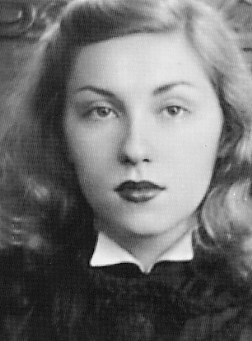
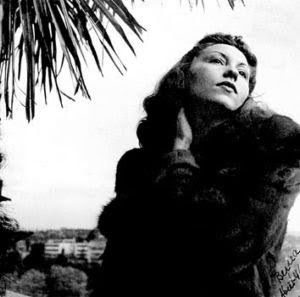
clarice02Clarice Lispector was born Chaya Lispector in a small town in Ukraine. Her parents and sister changed their names when they arrived in Brazil, fleeing oppression in their native country for being Jewish. They had suffered extreme persecution in their region and Clarice’s mother had been raped during one of the many pogroms. Marieta, her mother, contracted syphilis and believed that if she became pregnant she would heal. When Marieta died, Clarice was only 9 years old and the family was living in Recife, after a brief period in Maceió. After Marietas’s death, Pedro, her husband, decided to take Clarice and her sister Elisa to Rio de Janeiro in search of a better life. In Rio Clarice attended Law School and started her career as a writer, writing chronicles for a newspaper. She married a Brazilian diplomat and lived abroad for 15 years both in the USA and Europe.

Those who are fortunate to read Clarice Lispector in her original language, Portuguese, will marvel at her ability to create extensive monologues rich in painstaking observations of the human mind and soul. However, the many translations of Lispector’s work have done her justice and provide the foreign reader with the opportunity to immerse into a literary experience to be remembered.

clisClarice Lispector starts her novel with a little introductory note to her “possible readers”. She states that this book is like any other book but that she would be happy if it would be read only by people whose souls are already formed. It is quite a significant warning. It brings to mind the inscription at the entrance of Dante’s Inferno, line 9, Canto 3: “Abandon all hope ye who enter here”. It serves as an indication of what lies ahead waiting for the unsuspecting and unprepared reader. Clarice dives deep into the soul of her character, and by doing so it splits us open and bares our contradictory emotions and inner world liberating us from false Christian moralities. She calls for the redemption of the human spirit; redemption through sacrifice of all that seemed familiar and under our control.

G.H. is the quintessential iconoclast. She is the live goat offered in sacrifice on the day of our atonement. As in the Hindu triad, G.H. incarnates the force of Shiva, the destroyer and transformer by becoming one with the cockroach, the element responsible for her mystical experience and transformation. The sun invading the room is the source of creation itself as Brahma; the maid’s room as the preserver of forms in the figure of Vishnu. In this sense, the essence of life takes place, the essence of religion.

clarice_lispector_momentosOne needs courage to follow Clarice as those Argonauts had the courage to follow Jason in his quest to find the Golden Fleece. It is a risky journey filled with perils and challenges to be overcome. G.H. found herself face to face with her humanity and embraced her shadow not without fear or pain. We too feel the pestilence. We too get infected and experience the pustulous virulence wreaking its havoc in our bodies and minds, leaving us in a state of torpor and death. I too feel sick; my strength and life force evanescing languidly in that white room where G.H. met her destiny.

In the Passion according to G.H., the main character is confronted with her own pestilence. It is her moment to purge herself, but in order to get to this point she needs to cross the deep, murky waters of the rivers Acheron and Styx in the company of Charon. G.H. will traverse the rivers and enter the land of the damned souls; the ones who dared to touch the ignoble side of life and became contemptible and degraded. She had torn down the veil of ignorance and chased away the vendors in front of the temple just like Jesus once did.

clarice_lispector_frases_verdade_inventadaAs you immerse yourself into the world of G.H. you are possessed by powers that run so deep that you feel your body burning with fever as the virus consumes everything you knew until then. You need to be patient and let the virus complete its cycle so that the cleansing can take place within you, only then redemption can be achieved. It is the trust that you will be renewed, transfigured, rewired. Old dogmas and distorted beliefs no longer have a place in your heart. All ideas of what you’ve thought you were are surrendered to the chaos and the pestilence covering your soul. You embrace the pestilence within, the essence of what lies behind the cover, the shadow of your soul. Then you unleash the monster that you’ve become. It has always been there. You unite both sides and you let the beast run wild and free, and true, at last.

Like G.H., we also become one with the cockroach. We become one with the mud, with the repugnant and despicable part of ourselves. The initials G.H.  is not only the name of the main character but also stands for “Gênero Humano” (Humankind or Human Species.). It is not randomly that Lispector chose the name for her character this way. It is a mystical, philosophical and existential narrative.

clarice_lispector_me_abreceIt is not by chance that G.H. goes through her existential and mystical crisis in the maid’s room. The social tensions between the relationship of boss and house servant within the context of Brazilian social classes is much heated and goes back to the time of slavery. G.H. is the white and dominant element in the household. Janair, the maid, is present throughout the narrative and she becomes the driving force that propels G.H. into the whirlwind of internal dialogue that will eventually redeem her. Janair has the presence of silences and empty spaces bearing much weight in her seemingly anonymous presence. The maid becomes the ruler of the house, the one that exposes the awkwardness and artificial happiness of her “mistress”. These are two different worlds living under the same roof but apart from each other. The co-dependency and condescending relationship engenders a series of unspoken emotions. G.H. comes face-to-face with the implications of this surreptitious dynamics when she enters the maid’s room and finds the drawing in the wall. Race and social class is a convergent topic in Brazil. From the top of her upper middle class penthouse the main character observes the slums in the distance.

ng1346596To me, Clarice Lispector is a hurricane that whisks you away with violence and trepidation without much warning. She forces the reader to come to terms with the ugliness of reality and find redemption in their shadow. It’s a journey through hell in a literal sense. One must find solace in the company of a “helping hand”, in the case of G.H, or the presence of the poet Virgil in the case of Dante. Either way, one must have the safety of a friend that will anchor our spirit against the madness that surrounds us; in our case, Clarice is ever present by our side. If we brave through the darkness and face our demons, the vision of reality becomes soft and embraceable for we see nature for what it is, without the veils of superstition and mystic illusions.

As a writer in Brazil, Clarice Lispector was loved and hated. For many, she seemed too obscure and enigmatic; for others, she was a celebrated priestess and goddess. In her real life she kept a low profile and seemed unpredictable and provocative. American writer Benjamin Moser fell in love with Clarice and went on to write a biography of this Brazilian writer titled “Why This World”.

Amerikanische_Großschabe_1Brazil was entering one of the darkest periods of its history in 1964, the year The Passion According to G.H. was published. The coup d’état led by the Armed Forces would initiate a military dictatorship that would last for 21 years. Censorship, persecution and torture would then become the elements of a stifling regime that would provide a model for other military regimes and dictatorships throughout Latin America. Artists and writers became the bastion of resistance to the cost of their own liberty, and many times their lives. During this time, Brazil experienced one of the most creative periods in the Arts. As it is always the case, it’s through suffering and pain that the artist becomes more necessary as a revolutionary voice that tries to keep the freedom of their people alive in a heroic attempt to save humanity from the chaos of extinction and misery. We owe to them the right to keep our voices heard and our spirit intact.

Clarice-Lispector

To me, Clarice is a force to be reckoned with. She is a magnificent writer and a beautiful and charming and mesmerizing woman. We get to know her slowly. She reveals herself delicately. We miss her forever.

Clarice Lispector is one of those writers, like Franz Kafka, that need to be known and read world-wide. It is only by spending time with these minds that we get a glimpse of our own chaotic humanity. We only hope that readers will become acquainted with the world of Clarice and dare to investigate their worlds as they embark into the journey that will lead them to liberation from the constraints of outdated and pedestrian belief systems. Maybe this way, by changing our world, we can attempt to change the world at large one page at a time.

Here’s an outstanding and honest interview with Clarice Lispector at the studios of TV Cultura in São Paulo a few months before her untimely death in 1977:

I like visiting museums. From the Ancient Greek “Mouseion” – a place or temple dedicated to the muses (patron divinities of the arts in Greek Mythology), a building for the study and preservation of the arts. It’s not a place for old stuff, as many might feel. It is a place to feel inspired, renovated, transcended. Whenever I travel I take the opportunity to visit as many museums as possible. To me, visiting a museum is a chance to get in touch with the culture of a place in a more intimate way. A lot of people share the same interest and include museums as part of their sightseeing escapades. However, when we are back from our vacation, we seem to take for granted our local museums. How many of us can tell they have visited all the museums their city has to offer? Or, at least the main ones, thoroughly?

Art History

When I was taking an Art History class a few years ago, one of our assignments was to go to a local museum and choose a piece from the period we were studying and write about it. I was rather apprehensive since I wasn’t sure that I would find something that would fit the requirements of my assignment. I have to admit that I was underestimating the extent of our museums’ collections. Not only did I find the piece I was looking for but I also found out our museum had much more to offer than I had imagined.

The Lion-Shaped Rhyton:  Libations and ancient offerings

The piece I chose for my description was the Lion-Shaped Rhyton from the collection of The Palace of the Legion of Honor in San Francisco. This piece was found in Anatolia, a region comprising most of Turkey today. It is dated around 1860 – 1780 B.C., falling into the Assyrian Colonial Period during the Bronze Age where commerce formed a network of trading routes connecting the city-states. This object struck me in a pleasing way at first glance. Not only did I like it, but it was also different from other objects of the same period. Even though the description said it was a lion, I couldn’t actually see the resemblance. To me, it looked like a dog. Were there dogs in Anatolia 3800 years ago? Perhaps it is indeed a lion cub.

Looking

The material used is terracotta which is basically clay, and can be seen in various other objects like vases and statues. This Lion-Shaped Rhyton is a very attractive piece. I was surprised by its well-preserved condition. There are some cracks which were obviously repaired, but its overall appearance is intact, giving us a solid idea of what I looked like when it was made. The lion is painted in what seems to be a type of harness covering all its body, including a molded muzzle. The harness straps are painted in brick red with hard black outlines suggesting the idea that this animal might be serving a purpose, and therefore needs to have its animal instincts under control. It stands on its feet and its paws show clearly distinguishable carvings. The body of the animal can be seen in all areas not covered by the intricate network of the harness. It is painted in what seems to be mustard or tan and it has thin lines on its legs and its side hinting a soft fur. The vertical and horizontal brick red stripes with strong black outlines offer a striking contrast with the color of the body itself. Although the Lion-Shapped Rhyton is a small piece (it is 7” ⅝ in height), it has symmetrical proportions which renders balance and harmony to the figure. The lion’s posture imbues the object with imposing power and magnanimity. The menacing face of the lion with its open jaw showing sharp white teeth and large bulging eyes adds to its majestic and dominant demeanor, well-suited to the purpose it has. There is this peculiar protrusion on the back of the lion in the form of a cup. I didn’t know what a rhyton was until I saw this piece, but the data on the object’s tag calls it “a libation vessel”, and that I knew from classic Greek tragedies. Libation is basically the act of pouring a liquid (wine, water, oil) as an offering to a deity or a god. Therefore, our lion cub must have been part of religious ceremonies or rituals where a priest or priestess would pour liquid into a cup, give it as an offering, and maybe drink from it or pour it on the ground afterwards. The image of the lion is presumably being used as a symbol of overriding power, protectiveness and uncontrollable strength. These are qualities that benefit a creature invoked to take on the role of a cupbearer for a priest. It is interesting and tempting to note and speculate a variety of creative details that will enhance the definition of the object as a rhyton or libation vessel. Any visit to a museum offers the opportunity to immerse oneself in a world of stories and different cultures. You can have any kind of experience you like. Your visit doesn’t have to be necessarily academic. You can set the mood. If you are like me, you will previously go over the museum’s permanent collection and temporary exhibits on its website to get acquainted with the works you will find there, it surely adds to the excitement. A lot of people say they feel quite overwhelmed when visiting a large museum and they don’t know how to approach it. Well, unless you are, as a dedicated art history enthusiast, willing to spend six to 8 hours in a museum, you shouldn’t let the extensive art collection of these museums bring you down. Each person is different, and there will sure be a specific section of that museum that will hold your interest.

Do some research before you go to a museum. Don’t try to see everything. Concentrate on the areas you selected, maybe the highlights at first if you don’t have much time.

A lot of people find it easy to go into one room and pick one painting, for example, and then taking some time to look at it without any pre-conceived, academic notions. Just looking at the painting and observing it for what it is. It is telling a story. What can you tell from what you see in the painting? What’s your reaction to the way the elements in the painting were organized, color, subject material, methods of representation chosen by the artist and so on. Can you spend time enough that you can create your own story about the painting based on what you see?

Going deeper – Enhancing your experience

If you wish to go further, you can look up the data about the painting either on the museum catalog or the information plaque on the side of that particular painting and see if the description might open new perspectives and meanings to your initial observations. An audio guide might be a great asset to help with specific works as you explore the numerous rooms in a museum. Again, you don’t have to listen to every single work. You can hit play for the ones that draw your attention. The experience one has with art is both academic but, above all, very personal. It’s like savoring wine. You need to find the wine that fits your palate and explore the similarities and nuances as you find new ones. It’s an opportunity to learn something about you and let yourself be taken by the vision of a particular artist. Art is not something perceived from some distant realm or pedestal that only has an appeal to those stilted highbrow individuals that come up with complicated jargon to explain something that the artist was not even thinking about at the moment of creation. Art is about having the sensibility to be open to look at things with a fresh mind and unclouded eyes. It’s about having the joy in discovering new things, experiencing the different perspectives the world has to offer. In the end we are touched with something new and feel ourselves transformed by a new way of thinking. Next time you are at a museum, try and see the works from that perspective. Take your time to explore what you want. There are no formulas or codes of conduct. Choose one, two or three works, and if you leave the museum with at least one work that touched you deeply that in itself is a most splendid experience.

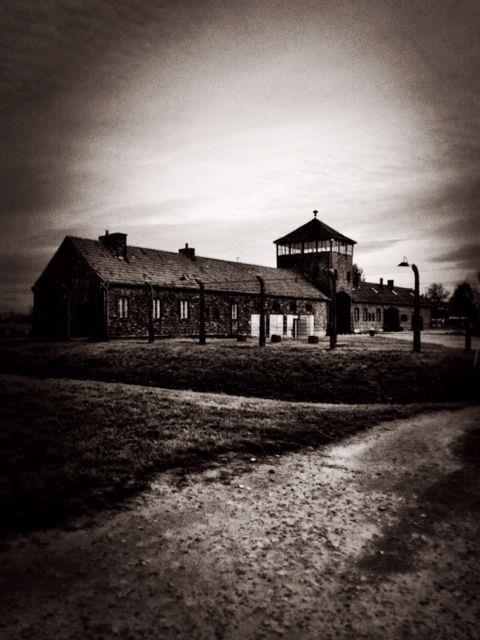
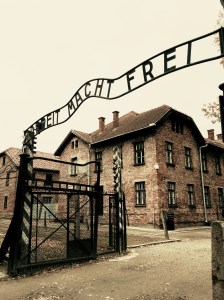
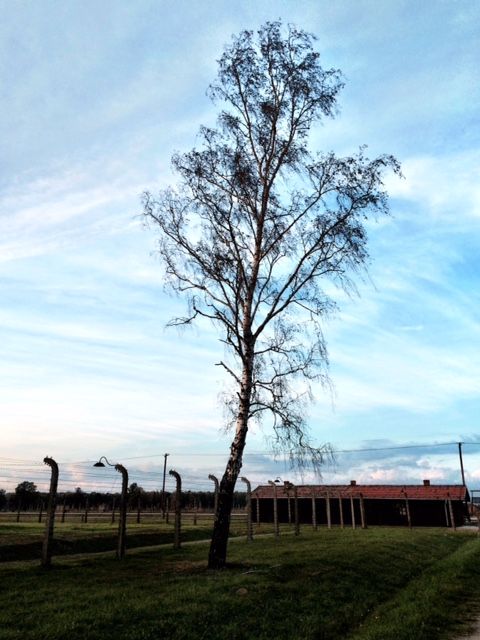
“Arbeit Macht Frei” – “Work will set you free”. Many crossed the infamous gate into Auschwitz. ManIMG_2360y never left. On the Fall of 2014, I visited Auschwitz-Birkenau, one of the most dreadful concentration camps ever created during the Nazi regime. I, too, crossed that gate into the experience of hell created by man.

At 7 a.m. we were at the bus station in Krakow waiting for our bus to leave for the town of Oświęcim, Auschwitz in Polish. The air was moist and cold with a temperature of around 43F. A slight drizzle covered the pavement. The bus left the platform on time. It took about ten minutes winding through the streets of the busy city center, which, at this time, had just woken up and filled the streets with locals getting their coffee fix while rushing onto crowded public transportation vehicles in order to get to work. Once on the expressway, traffic moved quickly but heavily. The skies were gray and the drizzle grew thicker. It felt comfortable and cozy sitting on my seat. The PKSiS line motor coach rode smoothly for the 1.5-hour long trip to Auschwitz.

11As we neared the region where the town of Oświęcim is located, other small towns along the road seemed simple, and comprised the mixed urban-rural industrial municipality of the same name. I had prepared myself for this visit by reading and studying everything related to the holocaust and the events and structure of the concentration camp. Despite all my preparations, I still couldn’t shake off the unrelenting uneasiness I felt inside me. I was anxious. As the motor coach approached the Auschwitz-Birkenau State Memorial and Museum, I pondered the details of the many people huddled together in a convoy of cattle cars arriving at this factory of death to a fate undisclosed to them. I felt how disoriented, scared and exhausted they were at that crucial moment in their lives when the train made its final stop and the living got up and went out to face their fates, while the dead, on the floor of the cattle cars, found peace in their final sleep during the long trip to the camp.

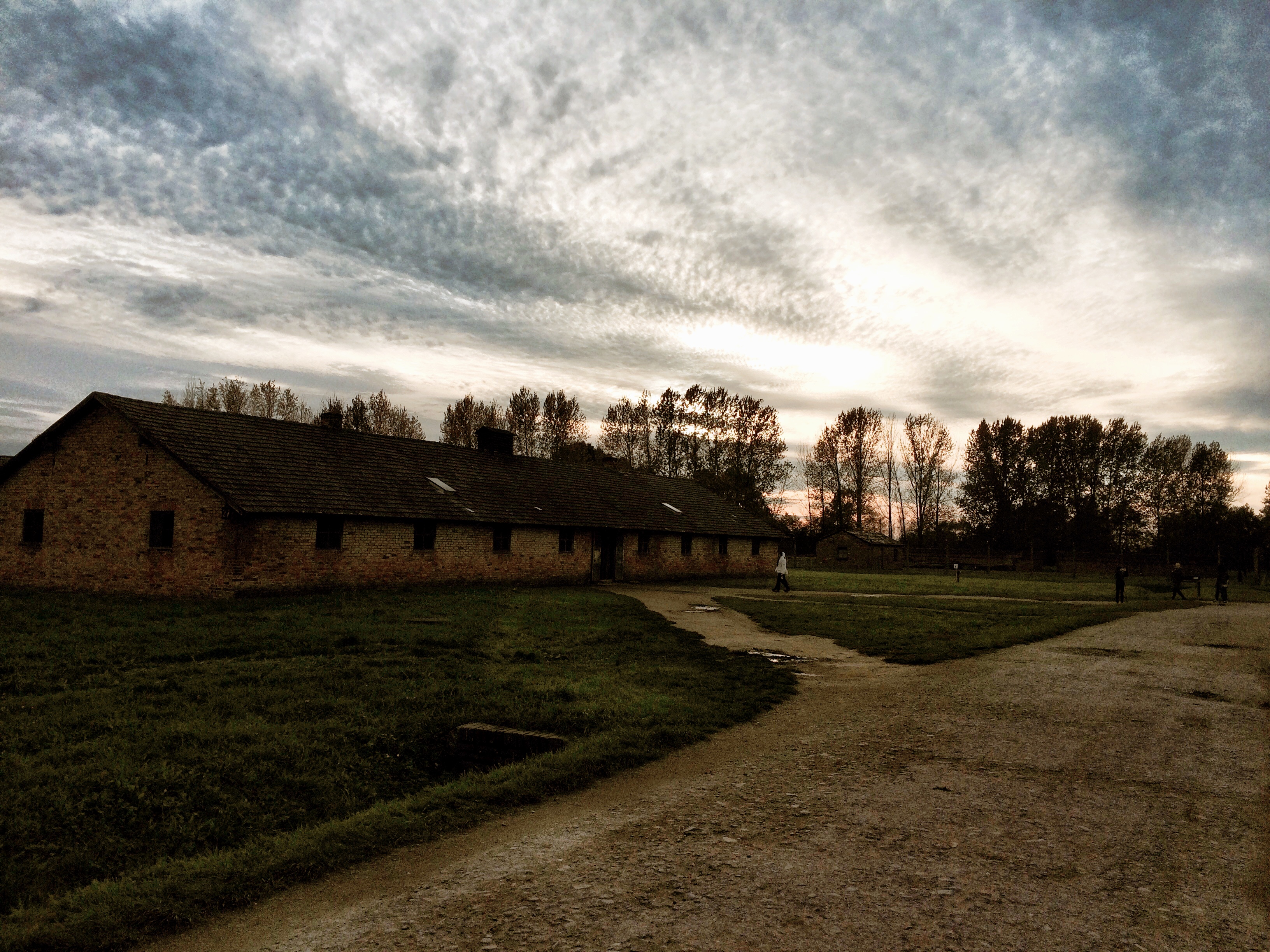
IMG_2380Visiting Auschwitz is never an easy experience. It is a meditation on life and death. We are confronted with our own fears in face of the dark shadow within each one of us. It is a cathartic experience since we observe those events guarded by the distance of time, but still, it scars our hearts with the suffering of human life no different than our own. We start in Auschwitz I, the main camp. The history of this camp dates back to the 19th century when it served as the grounds for Austrian military barracks. The SS (the paramilitary squadron under the Nazi Party) built the camp in 1940. Initially that’s where POW’s and political prisoners awaited their death sentences. The hideous future of the camp was, however, under way. This part of the visit is where you will find the exhibits occupying the original barracks that served as temporary shelters to the numbers of victims who perished there under cruel circumstances.
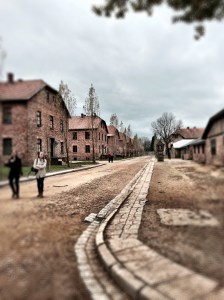
IMG_2378It is important to allow one full day for a thorough visit to this memorial site encompassing Auschwitz I and II, the latter referred to as Birkenau. Monowitz-Buna (aka Birkenau III was part of a sub-camp complex that used slave labor on the site of the IG Farben industrial complex owned by the Germans. A trip to this memorial to the victims of the holocaust is not to be taken lightly. One should embark on this experience as one enrolls in a university class in the sense that will demand dedication and observation. It requires patience, study of the human soul, objectivity, and above all, a deep sense of compassion for the lives of those who perished there, as well as for those who survived. The motivation to go is not only to remember, but also to educate ourselves and others so that the generations to come won’t be at risk of seeing it all happen again in different forms. In a way, in a smaller scale, similar genocide continues to take place all over the world, and, we, to some extent, still respond with silence and distance.

The Shoah is the word in Hebrew to describe the Holocaust. Shoah (in Hebrew: השואה) means literally HaShoah “the catastrophe”. To some Jews the word “Shoah” is preferred  to “holocaust” due to the religious nature attached to the word “holocaust” which refers to the ancient religious animal sacrifice being completely consumed by fire: from the Greek “holókaustos”: hólos, “whole” and kaustós, “burnt”. It is impossible, even with all evidence available today, to have a complete idea of the hideous crimes and the extent of the suffering undergone during life in the concentration camps. It is hard for the human mind to fully comprehend the reasons behind the horrors perpetrated by the Nazis. The Jews were the main target but other ethnic groups and peoples, who represented a threat to the Nazi ideology, were also affected, namely the Romani and Simi people (popularly known as “gypsies”), homosexuals, Poles, Soviet POW’s, political prisoners and dissidents, as well as the mentally and physically disabled. A walloping number of people were exterminated. Eleven million people were killed during the holocaust, of which one million were Jewish children alone. These facts and figures are unimaginable to anyone who hasn’t experienced the tragedy first-hand.

5 (2)bIt is even hard for anyone to understand and accept the fact that other monstrous types of genocide have happened after Auschwitz and still happen today despite the horrors unveiled after WWII. The Rwandan Tutsi Genocide in 1994 was another mass murder on the grounds of ethnicity, the Cambodian genocide in the 1970’s, the Bosnian genocide, the Israel-Gaza conflict, to name just a few of the ongoing massacre and crimes committed on similar circumstances. The numbers of occurrences of crimes against humanity is alarming and somehow brings to light an eerie prognostics that humanity hasn’t really learned much from the horrible mistakes perpetrated in history, and that it is up to each one of us to speak up and do our part so that these crimes don’t continue to be the characteristic that will define our species on this planet for the generations to come. It is so devastatingly sad and discouraging to admit that the human mind can devise plots that aim at the complete destruction of other ethnic groups or people different from the privileged class in control. It defies logic and decency that humans can create a plan to annihilate and kill thousands or millions of people without even feeling any qualms in one’s conscience. How is the distance and indifference created?

4

It is intriguing to observe that the same minds that devised the concentration camps, the tortures, the executions, the use of carbon exhaust fumes and later Zyklon B cans in the gas chambers, and the horrific system of disposal of corpses, were the minds of common men who led normal and healthy lives, not only within the sphere of their own families, but also in their personal and social lives. These were men who cultivated the arts, literature and classical music, who had spouses and children and spent quality time with them in leisure, like any other person. It is on this premise that Hannah Arendt so eloquently wrote her theory on “The Banality of Evil” during the Eichmann trial. Despite the controversial implications of Arendt’s observations within the Jewish community, one cannot fail to be puzzled, if not completely intrigued by the reasoning behind this analysis. It is rather shocking to observe that the minds that created murderous plans to exterminate so many people are really not much different than our own, and that just a twisted diversion in the perspective adopted when interpreting reality is enough to make one cross the line that qualifies our inherent humanity.

IMG_2381

From an epistemological point of view, all forms of knowledge are conditioned knowledge, and, therefore, based on our perceptions and personal experiences and resultant interpretations of a given situation, phenomenon or reality. Political ideologies come into existence out of a system of beliefs shared by the common interests of a dominant group that imparts those core beliefs to the public at large; this creates a support system that guarantees the survival and maintenance of the operative ideology and subsequent developments. It is within this scope that individuals adhere to incongruent political ideas in the beginning and later on struggle with personal opposition and dissent. The majority of the elements in a group, on the other hand, choose to follow orders without questioning or doubting, even if there’s a fiddlestick of opposition in their present views, for fear of the unforeseen consequences their actions might bring upon themselves. Others, nevertheless, don’t even bother to occupy their minds with questions or doubts, and, therefore, choose to perform their duties to the letter.

IMG_2379The system implemented in the concentration camps, and in Auschwitz-Birkenau in particular, was  so complex that it baffles the mind of anyone who tries to understand the internal workings of the effective organism the Nazis constructed. The procedures for this complex system was postulated in the  “Endlösung der Judenfrage” – the Final Solution to the Jewish Question, the euphemism used by the Nazis as they officially put into action the plan to exterminate the Jewish population through genocide in the Nazi-occupied Europe. The abominable plan had its beginning at the Wannsee Conference in 1942 resulting in the catastrophe that came to be known as the Shoah or the Holocaust. Two thirds of the Jewish population of Europe was exterminated in different forms but mainly by asphyxiation through gassing.

A lot of people wonder why the Jewish population seemed to accept their fate so passively and without revolt. However, the ideology supporting this industry of death had profound psychological implications that incapacitated the individual from inside out, extracting from each one of the victims their sacredness for life, the dignity of the human spirit. Few were the ones who were able to safeguard their spirits and survive. The annihilation of their humanity followed phases that eventually led them to meet their doomed destinies. When the segregation started, and their rights as citizens were denied, the first blow to their identity had been given.

IMG_2363In March of 1942 Birkenau opened its gate as the largest extermination camp in history. It initiated killing on an industrial scale. The transportation to the camp in those cattle cars, where people were huddled together during a trip that lasted days, was a lethal blow to their already feeble remnants of dignity. Many died of starvation, thirst and cold during the long journey. The ones who survived the trip would soon go through the process of selection upon arrival. This phase was also psychologically disturbing. Families were split apart when the women were separated from the men, while the weak, the sick and the children were exterminated right away. The physically demanding reality of the life in the camp forced these individual to abandon any bit of hope left in them. Faith somehow seemed pointless to some of them. They felt that even God had left them alone in their darkest hour.

IMG_2355It was hard to find a higher meaning in the midst of the chaos and tragedy. Only those strong enough to enter that sacred space were able to access the kind of power that kept them going forward and not giving up. The signs that one had given up were easily noticeable. In a given day, that one individual would just not get up, and lie, in their soiled straw-covered wooden bunks, in a unwavering state of torpor and apathy that proceeds that type of agonizing death. Torture, exhaustion, humiliation, illness, constant beatings and extreme weather conditions took its toll in a steadfast but rapid fashion. The organized system of the concentration camps, and in particular Auschwitz-Birkenau, was designed to destroy the individual from inside out, leaving no trace of dignity and humanity to serve as a stronghold or refuge for the human spirit. Still movements of organized resistance within the prisoners took shape internally in a secretive network of informants. That serves to illustrate that the Shoah was not passively accepted as many might think.

The philosophical axiom that “nations and governments never learned anything from history” is an intriguing starting  point of reasoning of the conditions we bring upon ourselves in the scheme of an absolute design of evolution. We seem to be intrinsically bound together by astringent universal laws that go beyond our seemingly disposition to attempt to control anything. It seems to me that it is in our attempt to understand that we give meaning to the chaos and embrace all phenomena for what they are.

IMG_2364

On this day, February 27th 2015, the United Nations invite everyone to remember the victims of the Shoah. It is the International Day of Commemoration in memory of the victims of the Holocaust. We remember always, but it is our duty to educate everyone so that that they, too, may be touched by the experience of this dark moment in the history of mankind, and how it has impacted our lives as we struggle with hatred, injustice, strife and genocide today, and make a commitment to free each other’s mental shackles of prejudice and  opposition; that we may be able to accept one another in all our differences, without threat, but with the understanding that there’s not one single truth, and that reality comes about when embrace it in its limitless manifestations, making it whole within ourselves.

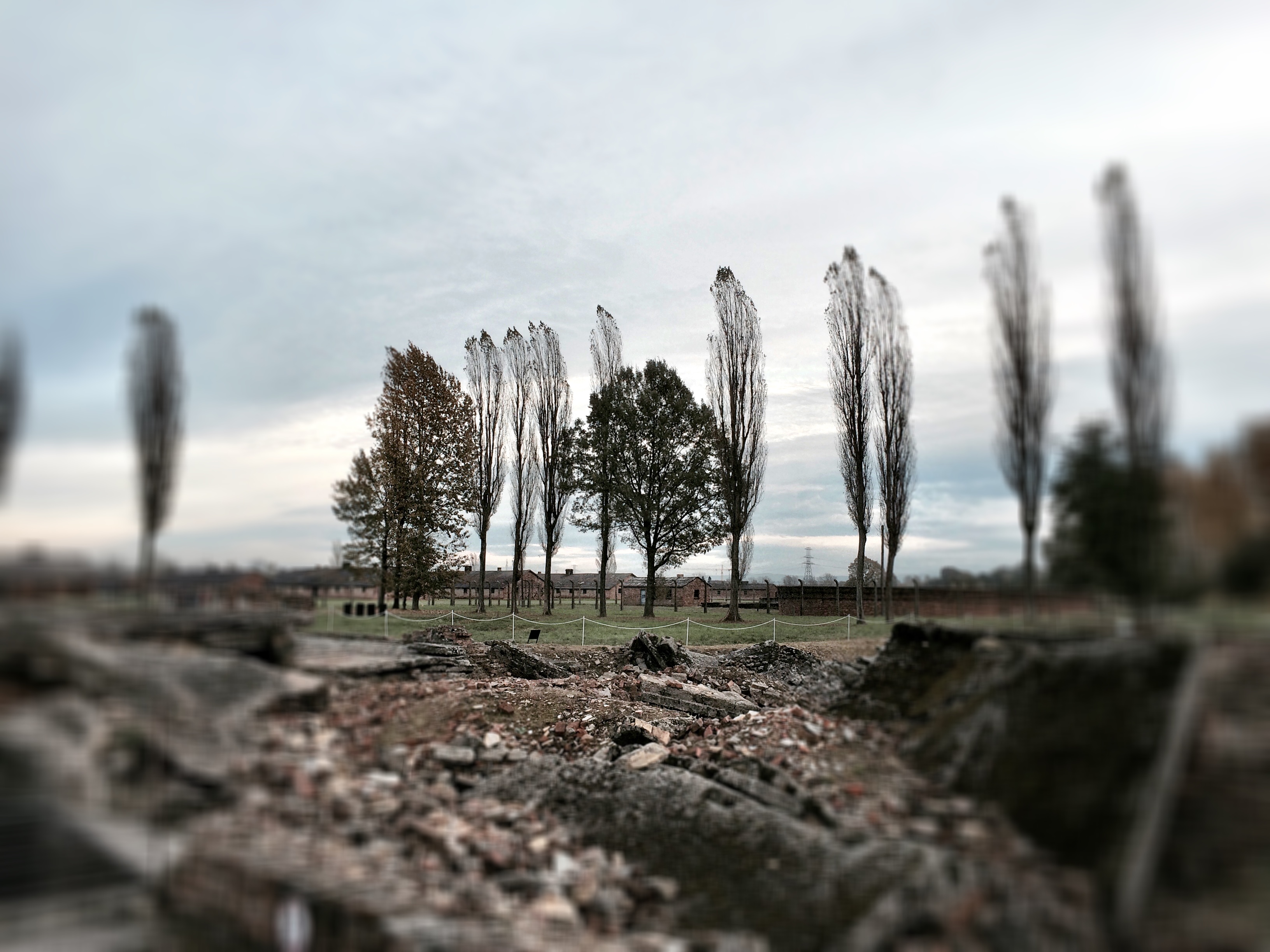
IMG_2354As I walked the grounds of Auschwitz-Birkenau I walked with them all. I communed with their pain. I carried the burden of their fragile bodies and listened to their voices echoing in my heart. I felt the cold breeze on my face. I heard the trees and the leaves whispering their names. I covered their corpses with flowers and love, and I assured them it was not in vain. I felt the Isolation, the longing. Lost and disoriented I succumbed to sadness, fear and anguish. I also felt peace in my heart and felt their warming smiles receiving my prayers. There’s beauty even in places we don’t expect to see. I have a feeling that they saw that as well. They felt the beauty and they cried and felt free.

IMG_2365I felt as if walking on well-known territory. I felt the heavy weight on my shoulders of my own pain. My tears welled up in my eyes. I had a knot in my stomach and a deep longing in my heart I cannot explain. I couldn’t grasp the multitude of emotions taking over me. I am there. I have always been there. It has always been in me. It whispered in my soul and I heard the cries for help in agonizing numbers, the cries for prayer and absolution. I thought about their pain and hope and lost memories.
I was there for a moment. I was there for eternity. I am there now. I will be there for all eternity. They sleep with me and I am with them in my waking hours. Never will I close my eyes again. Never will I dismiss the signs of the dark clouds that scarred our souls. The trees, the sky, they speak. They call their names. They call every name. They will call forever.

1

The confinement – the darkness – the cold – the wind freezing our hearts forever. The pages burned, the wings cut. The memories, the pain. The faces, the hope, the eyes. I heard the screeching sound of the architecture of the railway tracks echoing in the landscape. It spoke of dreams lost forever. It spoke of our silence. It spoke our names. The flames pulverizing our lives, burning our dreams. The trees confessed to the sky. It cried. It will cry forever. I’m lost and I’m found in them. Their presence welcome me and rejoice. I remember. I let them live. I let them know they are here.

WE REMEMBER – WE HONOR – WE GO BEYOND

I cried.

I dried my tears.

In vain,

my wounded flesh I watched,

Fighting to be alive.

Nature seemed indifferent,

distant, unresponsive.

Yet, like a beacon of hope,

Its luminous spirit drew my eyes up to the skies.

The world kept silent

While the agony stretched the fibers

Of my sorrowful and longing heart.

How much deeper can the soul of man submerge

In its ultimate search for the source of strength

Which transcends this pain inside?

The cries are inaudible now.

The pain, and the images of hell,

faded in the mists of time.

Lost in their scattered memories,

In this inscrutable silence,

I hear the voices again and again –

Like a raven’s call –

tearing the void of space inside my restless mind.

It was not in vain.

And we will forever remember.

Hope and faith

Will endure

And those cries will silence in our hearts.

We remember.

Life casts away the darkness

with the ever-present light of love piercing through time.

Instead of the raven’s call of death

which no longer abides,

We hear their laughter and feel their joy,

as we remember.

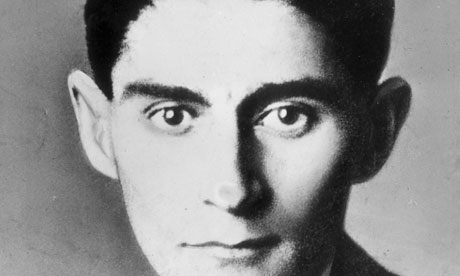
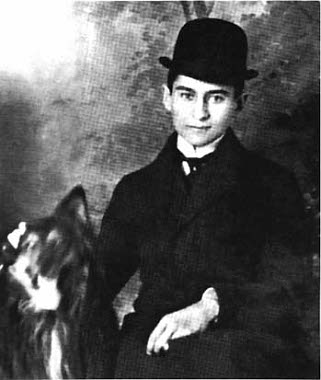
Franz Kafka was a solitary man. He was an artist and a visionary.

He was born in 1883 and died exactly one month short of his 41st birthday.

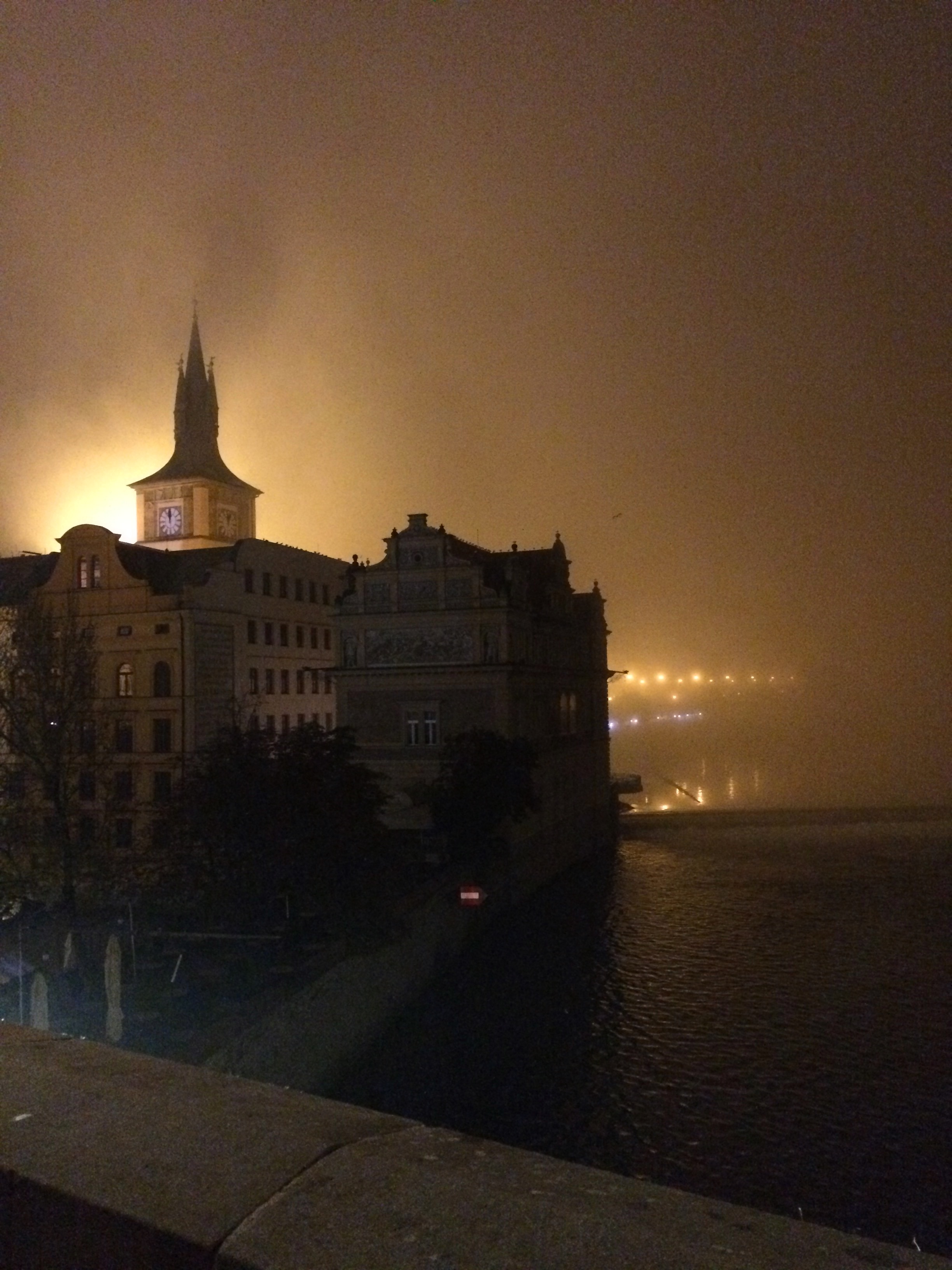
praguePrague is undoubtedly one of the most alluring cities. It is the capital of the Czech Republic in Central Europe. Little did I know that out of the 196 countries existing today, only 48 are landlocked; the Czech Republic is entirely surrounded by land. Kafka was born in Prague into a middle-class German speaking Jewish family. Herrmann and Julie were his parents.

As much as I would love to go on and on about Kafka, I am here to talk about one of his books that I just finished reading: “The Trial”. I was somehow familiar with the Kafkaesque style, having read “The Metamorphosis” when I was in college. However, “The trial” took me completely by surprise. This story grasped me in ways that would not let go of me. In some unconscious level I related to the leading character, Josef K, his motivation, doubts and existential landscape.

KafkaTrialTeeNever approach Kafka’s literary work thinking that you will be simply wading through the shallow waters of the weird and the fantastic because you will be seriously mistaken.  You’ll end up being brusquely carried away into deep, murky waters whose terrain hasn’t been mapped out quite yet. As soon as you make your way into the first sentences you are already entering a vast maze where your only safeguard, as a reader, is to surrender and trust in what Kafka is throwing at you. It is worth it. So is the case with “The Trial”, written between 1914 and 1915, but only published one year after Kafka’s death in 1925.

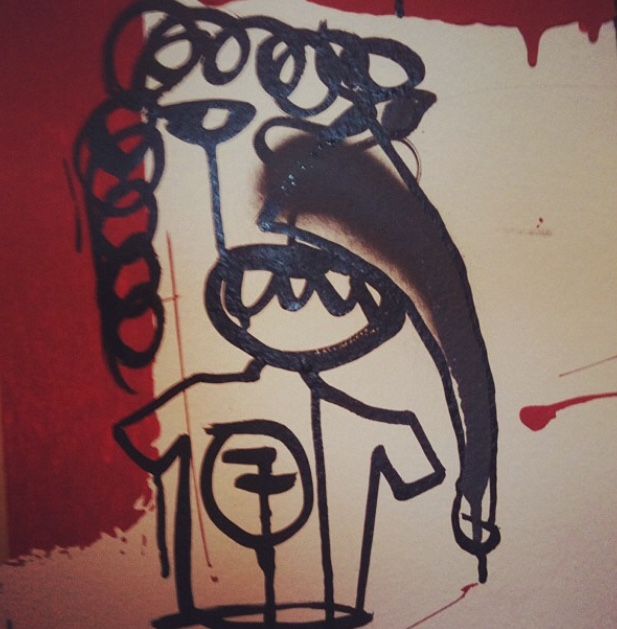
The story opens in a familiar pattern to me. Gregor Samsa, the leading character in Kafka’s The Metamorphosis, wakes up one morning to find himself transformed into a monstrous vermin. In The Trial, Josef K., in the morning of his thirtieth birthday is inexplicably arrested. In both stories the main characters are kafka-doodlefirst introduced to the reader by presenting them facing a predicament in their lives. We are thrown into the abyss of their existence without a chance to grab a good grip on reality and understand the facts in a reasonable manner. Kafka is thus inviting us to experience the trial ourselves the way K. is experiencing: perplexed, confused and dumbfounded. We can take a hint, however, and accept the unreasonable circumstances as a prescient sign of the events that follow suit.
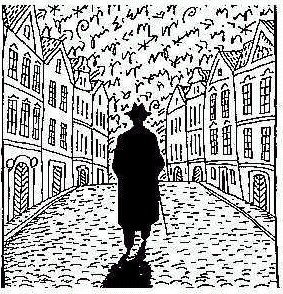
The undisclosed detail of the arrest and the court charges run throughout the story without much explanation. We never really find out the reasons why K. is being sentenced. In a way, we are also being charged and being tormented by an unspecified guilt. We can sense a feeling of doom permeating the air and taking us on a journey without return. After reading Kafka, the reader will never be the same as before. We follow Josef K.’s steps as if we were following our own path towards death; the death of our trust and belief in a system that never protected us in the first place. The landscape is as surreal as one can imagine, and no wonder the term kafkaesque entered our linguistic arsenal whenever we want to describe nightmarish scenarios evidenced by an ominous ethereal power hovering over the individual without ever being exposed for what it is.

kafka2The trial is full of inexplicable situations and innuendos. In his visionary world, Kafka created images that exude a sheer sensorial experience of an oppressive reality dominated by the power of forces that are clearly felt everywhere but hardly exposed in its whole. Like K. himself, we are left bereft of any hope of ever understanding how the court system works or how the trial and legal proceedings came to be. We dive deep into the nightmarish, authoritarian reality that K. is experiencing finding out, bit by bit, elements that keep revealing the helplessness of the individual within the legal system of the society displayed. The Trial was written in the period between wars. Was Kafka somehow foreseeing some of the crucial elements being formed at that moment that would lead up to WWII, and within that scope, anticipate our own future dominated by powers we can’t see or control? Was he at all aware of the fact that he would be somehow part of a literary style that created and discussed a dystopian world?

kafka5Well, Kafka wasn’t much interested in fame and it seemed he only wrote as a response to a strong inner urge. Before his death, he asked his close friend Max Brod to burn his manuscripts. Thanks to Brod’s act of disobedience, Kafka’s literary oeuvre survived and reached millions across the globe in the decades that followed his death. It seemed he wasn’t very confident as a writer. I wonder what he would have thought, had he experienced fame, success and recognition in his lifetime.

To what extent we can read into Kafka’s novels and stories and identify autobiographical elements we can’t really tell. He was a lawyer and worked in an insurance company. The tedious, bureaucratic office work must have influenced Kafka in his clear depictions of office workers. In The Trial, Kafka creates a dystopia where the workers function as mere pieces on a board game. The roles are compartmentalized. Individuals are responsible for their own specific area of jurisdiction and are not allowed to be fully cognizant of the intricacies of the entire court proceedings. They work as if part of an assembly line in a large production factory, thus resulting in social alienation and boredom.

To the court system, the information regarding K.’s crimes are not important and, therefore, never revealed. Since the trial is being held on the grounds of unexplainable reasons and accusations, the accuracy of the information is not really brought up into question except on K.’s part who insists on voicing his amazement and shock. The court’s decision to hold him guilty had already been previously and arbitrarily made, leaving no room for rebuttal. K.’s mistake from the very beginning was not taking the proceedings seriously. The preposterous nature of the accusations led him to behave carelessly; not that he would have had any chance of a successful outcome had he behaved otherwise.

kafka22When reading The Trial, we follow the protagonist’s steps cautiously because we are as clueless as he is about the incongruous reality of the totalitarian system we are about to find out. In a sense, it is also our own trial we are facing. We are also being scrutinized in our own lives and challenged with guilt for misconducts we are not even aware of. This is the world Kafka envisaged. It is not only a world he wrote about decades ago but a recent reality that closely relates to us. We live in a complex world dominated by a technology that brings the world together but, paradoxically, also brings forth social isolation and despair. The individual within a dystopian reality is nothing but a mere element devoid of meaning when taken outside of the group. It is the group as a social and political entity that supports the system. It is the role each one will play that guarantees their function and reason to exist. Kafka also felt oppressed by the requirements of his professional life. As an individual he was an intellectual, a writer, and his day job would somehow take most of his time and drain the life away from him.

005cgIn his peculiar journey, K. becomes the eternal wanderer, a twisted version of the literary flâneur of 19th century France. For as long as he lives, his will be a fate shackled to the whims of an all-too-powerful and ubiquitous court system that will stop at nothing to bring him down. He is chained, so to speak, to the commands dictated by the web of bureaucracy that consumes and confounds anyone as they struggle to defend and save their own lives. In K.’s case, his life is already doomed from the start. He questions the system that holds his life together with a smug pride noticeable in those intellectually privileged minds. K. is definitely not the common man. He is the element of entropy in this totalitarian system, and needs to be eradicated as weed must be cleared out from a flower bed, so that unyielding powers of the ruling class can survive and flourish. His presence and demeanor is in direct opposition with the role he is expected to play. It’s his refusal to accept the facts placidly that triggers the chain reaction which will culminate with his own destruction.

kafka26

In The Trial we are all condemned in innocence but also in ignorance, observes K. while visiting the court building on a Sunday, only to find out that the place is empty and decrepit. Every detail, he notes, is devoid of meaning and substance. It is in this series of events that we, as possible protagonists of the same story, put into motion, with the way we choose to respond, the succeeding state that will delineate the course of the proceedings. The outcome is already decided. The course and duration, however, will be determined by each one individually. Some choose submission, and are, therefore, able to prolong their ordeal indefinitely in the case of Bloch; others, like K. will struggle and question, and flail their arms about in a hopeless statement of freedom. The verdict is clear: there is no freedom; at least not without the cost of one’s own life.

Franz-Kafka

It is interesting to observe that the world Kafka created is so present and active in our lives today. We are all somehow under the governance of questionable social organizations, political ideologies, religious dogmas and tenets, unjust economic systems and dysfunctional social structures.  We walk around pretending to be free, but, sometimes, with our heads lolled on our chests, we are well aware of the fact that our fates have been decided from the very beginning.

First and foremost, this post carries a disclaimer that I’m not, by any means, in a position to be an authority on parenting. I do not have kids. But, as an only child, I was fortunate to have the beneficial distance and detachment that facilitated my own observations on family life, and the interactions therein. Henceforth, it is only as an observer that I dare present my opinion on this topic.

I recently read Steve Rose’s blog post “The Meaning of Having Children” and a lot of thoughts and old opinions came to mind. In the past I was very much biased by the notion that children were nothing but a nuisance in a couple’s life, preventing them from fully enjoying each other and exploring life together. I only saw the cons of having children. I could not see past this personal judgment, maybe because being an only child myself, I was stereotypically influenced by selfish and egocentric views of reality where my interests had to come first. As I grew older, however, these static notions began to shake the very foundations of my settled opinions on this topic.

Overpopulation!

I still hold close to my belief that having children is a difficult decision. In a world that is suffering in all areas due to overpopulation, deciding to bring another being into existence is a choice that must be considered carefully from all angles. We just need to look around or hear the news to be aware of the perils and hardships we are facing now due to the number of people living on this planet. The future looks even more dismal if the number of people increase and we can’t find the proper solutions to the problems already putting human life at the risk of possible extinction. Maybe, each affluent couple, who wishes to have more than one kid, should adopt another to each new child they bring to life. It  would not resolve the population problem, but it would, at least, give an opportunity to orphans and abandoned children to have a better life.

To aggravate the issue, there has always been a chasm between generations, a fact which adds to the challenges of raising a child. The responsibility of providing a healthy environment where a growing individual can have the opportunity to thrive and become their best in life starts with the relationship between the parents and the child from the very beginning. A two-way honest dialogue between the parties needs to be practiced and emphasized on a regular basis as part of daily communication at home. In our sophisticated technological world it is easy to isolate ourselves at the end of the day, and hanging out with the family can be seen as a boring and useless chore, or a waste of time. When families face this problem with a teenage son or daughter, it is very difficult, if not unlikely, to revert the situation and go back to a time in their lives where communication and quality time could have established the foundation that would have created a strong bond at home.

Investing on your kids can be lucrative in the long run – some may still think!

In many cultures across the globe when a couple gets married and starts a life together they already follow a pattern perpetuated by generations of families that came before them. In a lot of poor countries, children are seen as a profitable investment for the future, of not only the parents, but also of the whole extended family that might be economically less privileged than their younger counterparts. These parents usually do no use contraceptive options, either based on religious beliefs, or because they want a large family that will help them by boosting the household income in the future. The money invested in the children’s education will guarantee that they will pay it forward by becoming main breadwinners for the family. It will be their responsibility, when they grow up and graduate, to help and support not only their parents and siblings, but also other members of their extended family. Everyone will come to them to remind them that the position they have now in their lives is, to a great extent, because of the financial help they received when they were young. Not being aware of this extensive debt they acquired when they were simply going to school and being good kids, they now have to forget about themselves and their dreams and work as primary sources of pecuniary maintenance, many times working abroad away from their loved ones in a sort of voluntary exile. It is a hard price to pay.

The right reasons – the right moment – the options

It is imperative to be clear about one’s reasons for having children. Sometimes a couple, who has been married for so long, live desperate, unfulfilled lives together in their failed attempts to have a child at all costs. People can go to great lengths in order to procreate. In many of these cases, marriages fall apart due to blame and feelings of inadequacy and failure. I always think that if a couple tries hard to have a baby, and for some genetic problem, or other factors, is unable to conceive, they should consider adoption. Adopting a child is a life-affirming act of compassion. We all adopt pets all the time to give them a chance to have good, healthy and happy lives. We can certainly embrace an abandoned child with the same attitude. It is the ultimate act of love.

Nobody can argue that caring for another human being is an act of altruism. It surely fills one’s life with meaning and purpose. However, the dynamics of family life is not always so simple and modest. Parents and children are growing together, and in the process, the parents’ traumas and unresolved emotional issues are certainly coming to the fore as they get triggered by the experiences brought about through the close interaction. Each member of the family has a role to play in order to maintain the structure of the family life. Regardless of how healthy the relationship might be, parents are still the figure of authority in the landscape of the household, and, thus, will have their position of control questioned at times and even rebelled against.

Being a figure of authority and a role model

We often tend to gauge the degree of immaturity a teenager has based on their behavior and unyielding opinions. Most often these are underlying symptoms that indicate a predominant crisis the adolescent is going through in face of an inability to cope with a given situation. This crisis might have sprung out of a specific situation outside the family space or originated within the very core of the child’s home. Parents must constantly reevaluate their own behavior within the sphere of the marriage, as well as in relation to their children and every other social interaction. Children pick up easily on these dysfunctional nuances in their parents behavior, and will react to them differently. The family space at home is a learning ground where everyone is learning together; parents need to observe their own responses to life, lest they don’t fall into the same parenting traps they have always vowed to never repeat.

In a way, parents fail to grow and change when given the opportunity to look at themselves in their children and face up to their own fears, doubts, insecurities and shortcomings. Instead, they go on pretending to be a final product, with a self-imposed idea to be an impeccable role model, expecting their children to buy into that notion as they grow up. The children eventually catch on to the travesty of morality imparted to them and the sham is sadly uncovered.

Procreation as a purpose for one’s life

There’s an insurmountable amount of pressure put on women to bear children. It becomes the sole purpose in their lives. This stress can be devastating. I know a couple whose husband had become adamant in his decision to not have children. He felt incapable of raising a child for fear of making the horrible mistakes his parents, allegedly, have made with him. In his case, his own experience as a kid had marred and destroyed his qualifications of ever becoming a parent. This couple separated for a while only to go back together years later because they really loved and cared for each other so much. However, he would not compromise and his wife was the one who had to do the ultimate sacrifice of never fulfilling her motherly desires in order to stay with him. Even adoption was out of the question.

It is imperative for the parents to cultivate an honest relationship with their children. In order to do that, both father and mother need to be brave and humble enough to embrace their vulnerabilities as well as their strengths. There’s nothing more inspiring than to see your parents as human as you are, and knowing that they won’t always have the best answers or advice to the challenges in their lives, but that they will be by their side as they figure it out. Parenting is never finished. It is a constant learning process of being in relationship with each other. It’s knowing the moment to talk, but also being present and open to listen without judgment or preconceived notions colored by one’s own experiences. It is important to be present and be willing to see things with a fresh mind, much in the way Zen Master Shunryu Suzuki called “beginner’s mind”.

I can imagine the joys of raising and caring for the well-being of a child. I was fortunate to be around one of my friends’ struggling years as a single mom. We were able to step in and help her every day since we were all neighbors.  When her kid came into our lives he was only 3 years old. The memories and bond we share are priceless. Today he’s almost 18 and the trust and respect we have was brought forth during his early years with us and the honest approach we all had towards him. Experiencing life with a child is an opportunity of renewal and growth. It is important that we don’t offer a false identity of who we are in our quest of being role models. The child needs to see the adult with honesty in every stage of their lives. When we are in contact with a child we are often reminded of the beautiful things about ourselves, especially the spontaneity we hid behind the veil of illusion of what an adult should be like in order to fit in.

Seeing the world through someone else’s eyes is a remarkable and life-changing experience. We step out of ourselves and accept different perspectives; we open space for dialogue, understanding and healing. Resistance happens because of fear. Fear is the root of many dysfunctional interactions at home and in society at large. It takes courage to let go of fear and to look at your child as a complete individual other than who you are or what you want them to be. That’s when real parenting starts.

Ab ovo is a Latin term that means “from the egg”, “from the beginning”. Thus, we restart our lives every single minute, every single hour, every single day, and every single year. All the time we are given the opportunity to choose how to respond to life. We have freedom of choice.

Since time immemorial human beings have tried to control nature and reality to make our lives more predictable, and therefore, less scary in face of adversities. However, the impermanence and unpredictability of life circumstances are an intrinsic characteristic that challenge our notions of reality and our need for control.

street artRegardless of factual evidence that puts us in direct contact with the essence of reality, we struggle in vain to hold on to the notion that we can control, and even avoid the inevitable winds of change. Our fear of surrender to the unknown spawns a series of symptomatic behaviors in the form of neurosis. We become entangled in a web of mental instability that brings us much inner suffering and pain. This phenomenon starts in the mind as a thought begins to take shape and eventually becomes a feeling that takes hold of us distorting our perception and wreaking havoc in our lives. First a thought arises in our minds coloring our views of reality, then our behaviors set in by interpreting that reality according to feelings triggered by the seed thought.

headIt is the nature of the mind to create stories and try to explain events and situations by making up its own interpretation of reality. Thoughts are energy manifested in the brain, and as we listen to our thoughts we create a reality based on the thoughts by interpreting the reality we see. The emerging neuroses (anxiety, obsessions, mental confusion, phobias, negativity, aggressiveness, perfectionism etc) we experience are actually epiphenomena of our basic primordial fears that stem from our fragile condition as humans living under the universal laws of nature.

It’s time we learned to live in harmony with the world around us, trying not to separate ourselves from nature, but, on the other hand, perceiving the similarities that bind us together to every single component in existence. Our thinking minds create the illusion of separateness and duality throwing us into a dichotomy of good and bad, right or wrong, and so on. We find our niche in the middle of a mental confusion and we get ensconced in dysfunctional behaviors that give us a false sense of security and identity and we suffer. The suffering originates from our inability to lose our grip on the things we cannot control, simply working with what is without resistance, truly exercising and embracing acceptance and gratitude in every day of our lives.

flower

Acceptance is not an act of passivity in face of problems but an act of courage and a willingness to work according to the flow of nature, in perfect harmony with events that we can’t control. The Universe is never against us. We are part of the same process of creation, with the ability to change and co-create. The sweet dream of illusion covers our mind with a subjective mist that interprets reality based on our own perceptions. Our relationship with other people, and with everything in life, is tarnished by the interpretations we are constantly making in our minds.

There’s really nothing to be gained through resistance. In the end, events will follow their natural course leaving us exhausted and in pain. It is a practice, and like any other new habit we try to adopt, it requires patience and constant observation. We become observers of our own minds and behaviors, and in the process, we get closer to the very essence of who we are. By observing our minds thinking, we can spot the erroneous perceptions and struggles to disguise our fear by trying to control that which we cannot control in an attempt to go against the impermanent nature of life. Instead, we need to find ways where we can become better surfers of life by riding the waves of change with grace and boldness.

springAcceptance is the complete surrender, not a sanctimonious attempt to sound lofty or special. Acceptance is the act of trusting unconditionally with your entire being in all aspects of our lives. It is the supreme act of humility and surrender. When one accepts, one transcends the pain through trust and surrender. It’s a letting go of everything that fetters. The mind is always arguing in a play of opposites. The duality the mind experiences can set the individual into the realm of illusion, or Maya, the Sanskrit term in Hinduism; it’s the veil that covers the true nature of who we are in relation to everything else; it goes hand in hand with gratitude for our lives and our experiences; gratitude for the divine miracle of being alive and evolving.

circles

On this note, I wish everyone all over the world a happy new year and a happy, fulfilling living – to all those who are happy, healthy and well, and to those who are suffering and in pain, angry, perhaps, indifferent. May everyone be blessed and find the source that brings it all together. Happy new year to everyone all over the  world, all peoples everywhere; all living beings all living creatures in any form: animal, human, plant life, rock life – anywhere, everywhere.  May the universe accept our prayers and our lives and bless us with the divine light of the spirit who created us, the Divine Source, Creation Itself, present intrinsically within each and every single person, in every single representation of life on this planet throughout all universes and beyond.

James-Carpenter-as-Ebenezer-Scrooge-in-A.C.T.s-A-Christmas-CarolEbenezer Scrooge was not a bad man.

He was human. He was stuck in his old habits built around fear. He was afraid of being poor, so he surrounded himself with the only thing that mattered most to him, and that was money, and making money grow. He was scarred by a lonely childhood and he protected himself in the only way he knew how, even if it cost him his innocence and joy for life, and the relationship with those who loved him nevertheless.

Thus it starts the classic and popular Christmas tale Charles Dickens penned in 1843 when it was first published. I went with a friend of mine, who had been hinting her interest in enlisting someone to accompany her since she had never seen the play before, that person being me, of course. I had seen the show a couple of times in the past and wasn’t exactly thrilled to jump in the opportunity of yet another performance. However, I took my friend to the theater, not letting her know where we were going to, and we had a wonderful time.

ACT’s new approach to Dickens’ tale was as dull and stale as Mr. Scrooge’s dingy sleeping chamber. There were faint blows of fresh air here and there, not quite making justice to this classic novella withal. One can understand that the adaptation had to be cut down to some essentials lest the little ones, who were in the audience, would not be induced to an early slumber in the middle of the story. However, we should not underestimate the ability children have to capture complex nuances and innuendos. At times, the production veered from a steady course and embarked into silly meanderings. The ghastly figure of the Ghost of Christmas Future is a phenomenal set piece that will surely remain in the memories of both the children and adults who attended the show. The cast was uneven, however. Some stellar performances stirred the story while others barely convinced us of their intentions. Still, Dickens’ story communicates a powerful message to those who heed him. All in all, ACT’s annual tradition of giving us A Christmas Carol still warms the heart and keeps the lights of the season ablaze.

A Christmas Carol talks about the importance of family and friends above all else. It shows us that despite money and material gratification, if we don’t allow ourselves to connect with others in a deeper level, life is devoid of substance, and we will be left wondering at what point in our lives we made that wrong turn. We are reminded of the things that truly makes us happy and fulfilled in our lives and we go back to the simplest pleasures we can remember, like playing by the beach with our parents and siblings when we were kids, being lulled to sleep to the sound of our aunt’s or grandma’s voices as they told story or sang to us, or when we had a glass of wine with friends and shared the laughter and tears later on down the road. The simple memories of joy are the things that stay with us in the dissonant verbiage activity of our busy lives.

hanna_1Not too long ago, I had the fortunate opportunity to re-encounter an old friend. We hadn’t seen each other for nearly two decades. I was nervous, thrilled and grateful that I was going to see my friend again after all those years. We drove on small roads passing quaint little towns along the way until we arrived at this small village in the countryside. It was mid-fall so temperatures had gone down a bit and the air was moist and crisp. Gray skies hinted the possibility of rain later on. I could already picture the whole place in the winter when the snowfall turned everything white. At this time, however, the land was still green, but the thick fog, due to a large body of fluvial water nearby,  covered the landscape in its romantically somber mist.

After some time we arrived at her house. The joy we experienced is indescribable. After warm hugs and long stares at each other we all went into her snug home. Every detail in her place was carefully selected and reflected her charming personality and character. We had beer, pizza; wine and coffee with chocolate and cookies, and deep, heart-felt conversations. We only had a few hours to catch up on each other after all this time. We had so much to talk, so much to listen. We learned about our struggles and sufferings and hardships, as well as our joys and challenges conquered. I looked at my friend, deep inside her eyes, deep inside her soul and communed with her. We understood each other. We saw the presence of life vibrating in our bodies. How strong she is I thought, and, without a word from my side, she acknowledged my realization and admiration for her courage during the difficult times she had endured. We felt each other communicating in a different realm, far beyond the ambiguities of the spoken language. The language was there only as pointers during the course of our conversation, but our hearts knew it better and did most of the talking for us. Then the time came to say our good-byes. We hugged, kissed, and cried, and we promised to see each other again soon. Outside, night had covered all in darkness, and we saw nothing but the headlights illuminating the road as we drove away. We were silent; our hearts, filled with joy, gratitude and love.

At times, I had tears in my eyes as I watched A Christmas Carol this year. Dickens’ story is far deeper than any adaptation of his work. For the first time I really understood what Dickens was trying to impart. For the first time I understood his message clearly, not intellectually as many times before, but with the heart. It is about the connection we have with others; the compassion we feel in our hearts, the ability to be by each other’s side and suffer together, strengthening the ties. Only thus can we truly be happy together and laugh, and celebrate our lives.